Abstract
This article defines Identity 4.0, a zero-trust framework for providing verifiable digital identities to non-human entities, primarily autonomous AI agents. It addresses the security and accountability gaps in traditional identity systems, which are not designed for the scale and autonomy of AI.
The proposed solution is a Know Your Agent (KYA) protocol built on W3C standards for Decentralized Identifiers (DIDs) and Verifiable Credentials (VCs), along with Zero-Knowledge Proofs (ZKPs) for privacy. The article outlines the technical components, the anatomy of an AI agent’s identity, and positions RNS.ID as a key enabler of this technology.
Identity 4.0: Unlocking the Future of AI Agent Identity
Digital identity is evolving. We’ve moved from government-issued IDs (Identity 1.0) to social logins (Identity 2.0) and, more recently, to self-sovereign identities on the blockchain (Identity 3.0). Now, we’re entering the next phase: Identity 4.0.
What is Identity 4.0?
Identity 4.0 is the next generation of digital identity, designed to provide verifiable, decentralized identities for autonomous AI agents. While previous identity models focused on humans, Identity 4.0 extends the principles of self-sovereign identity to the rapidly growing world of non-human actors. It uses a zero-trust architecture, meaning no agent is trusted by default, and every interaction requires cryptographic verification. This framework is essential for establishing trust, security, and accountability in a digital economy where AI agents manage sensitive tasks.
This article explains the core concepts of Identity 4.0, the technologies that power it, and why it is critical for the future of AI. For organizations looking to implement these principles, solutions like RNS.ID provide the foundational tools for this new era.
Why Do AI Agents Need a New Identity System?
Traditional identity verification systems, such as Know Your Customer (KYC), were built to verify human users. They are fundamentally unequipped to handle the scale, speed, and autonomy of Non-Human Identities (NHIs), which include API keys, service accounts, and, most critically, AI agents, a concern echoed by cybersecurity leaders at NIST. This creates three major security risks:
1. Compromised Credentials at Scale
AI agents can be exploited to steal credentials and mimic human behavior, leading to large-scale security breaches. The World Economic Forum has identified the proliferation of NHIs as a major cybersecurity threat.
2. Lack of Granular Control
NHIs are often granted overly broad permissions, creating significant security vulnerabilities. According to cybersecurity firm Palo Alto Networks, managing these identities is a top priority for modern security teams.
3. Accountability Gaps
Without a reliable way to verify and track AI agents, it is nearly impossible to determine who is responsible when an agent causes a financial loss, data breach, or other harmful outcome. This lack of accountability is a major obstacle to enterprise AI adoption.
To address these challenges, a new identity paradigm is required—one that is built for the machine economy.
What is the “Know Your Agent” (KYA) Framework?
Know Your Agent (KYA) is the proposed solution to the challenge of non-human identity. It is a new trust and security framework designed specifically for verifying and managing AI agents.
KYA is a trust protocol for the agentic economy. It’s a way to answer the most important questions about any AI agent, as the Silicon Valleys Journal puts it:
“The existing infrastructure…can’t answer the most basic questions about autonomous agents… Who is this agent? What is it allowed to do? Why did it take this action? And who is accountable when it misbehaves?”
It extends the principles of traditional KYC to the machine economy, answering three critical questions for any AI agent:
- Who is this agent? (Authentication and Provenance)
- What is it allowed to do? (Authorization and Capabilities)
- Who is accountable for its actions? (Accountability and Auditability)
Identity 4.0 provides the technical backbone for the KYA framework. It uses a combination of decentralized technologies to create a secure, transparent, and accountable environment for AI agents. This approach is gaining traction in the industry, with thought leaders like Gartner emphasizing the need for AI trust, risk, and security management.
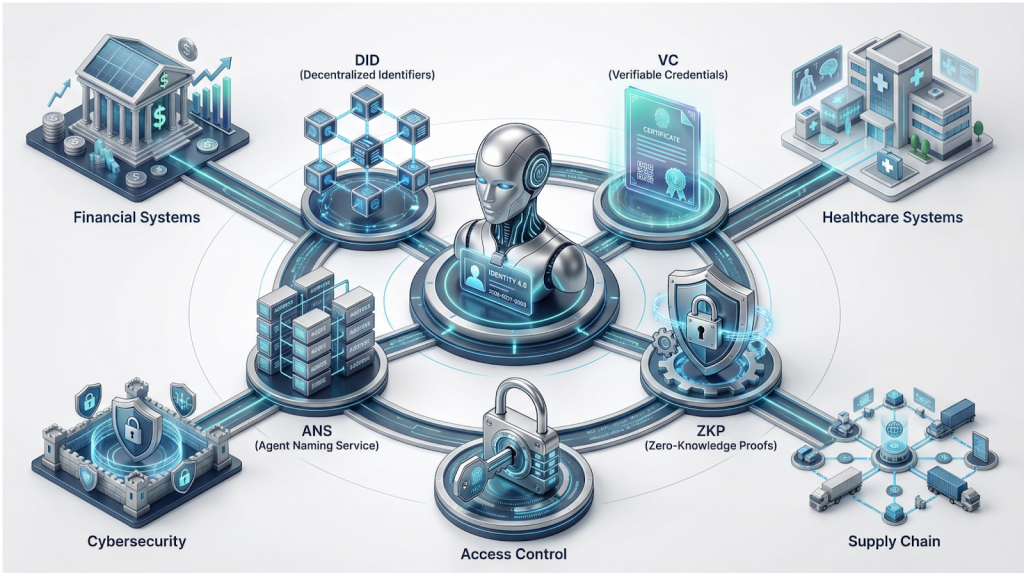
The Identity 4.0 framework provides a clear, secure, and accountable structure for AI agents.
How Does Identity 4.0 Technology Work?
Identity 4.0 is built on a foundation of three core decentralized technologies, as outlined in recent academic research on zero-trust frameworks for AI. These technologies work together to create a robust and private identity layer for AI agents.
Here are the core components that make it work:
1. Decentralized Identifiers (DIDs)
Think of a DID as a universal, permanent ID for an AI agent, a concept that has been standardized by the W3C. It’s unique, globally recognizable, and not controlled by any single company. This gives the agent a secure, independent identity that it controls. For a deeper dive into how this technology works, check out the RNS.ID documentation.
2. Verifiable Credentials (VCs)
VCs are digital badges that attest to specific attributes about an agent, based on the W3C Verifiable Credentials data model. They can verify an agent’s skills, permissions, or security clearance. Because they are cryptographically signed, they are tamper-proof and can be instantly checked by anyone.
3. Zero-Knowledge Proofs (ZKPs)
This is where it gets really smart. ZKPs allow an agent to prove something is true without revealing the information that proves it. For example, an agent could prove it has permission to access a system without showing its actual permission file. It’s the ultimate in privacy and security.
Together, these technologies create a powerful, layered security system. DIDs provide the core identity, VCs add verifiable attributes, and ZKPs ensure everything can be checked with complete privacy. This zero-trust approach means no agent is trusted automatically. Every action requires verification to ensure a secure environment for everyone.
What Information Makes Up an AI Agent’s Identity?
An AI agent’s verifiable identity is not a single piece of data but a comprehensive profile that defines its attributes, permissions, and history. This structured metadata allows other systems to quickly verify an agent and decide whether to trust it.
According to the standards being developed by industry groups like the Decentralized Identity Foundation (DIF), a complete agent identity should include the following components:
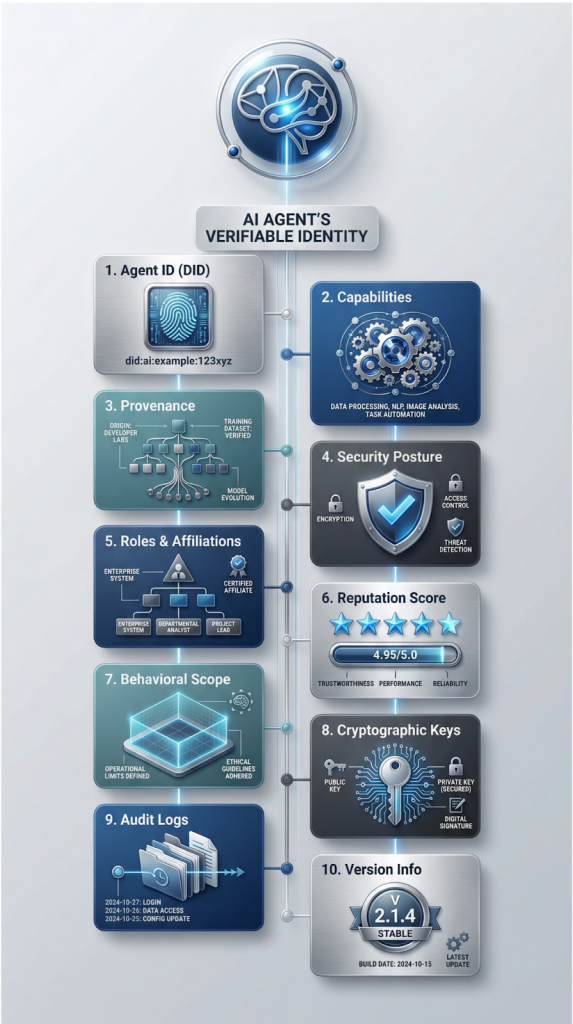
A breakdown of the core components that make up an AI agent’s verifiable identity.
- Agent ID (DID): A unique, permanent digital ID for the agent, giving it a stable and recognizable identity.
- Capabilities: A verifiable list of the specific tasks and actions the agent is authorized to perform, preventing it from exceeding its mandate.
- Provenance: A cryptographically signed record of the agent’s origin, including its developer and version history, to ensure a clear audit trail.
- Security Posture: A set of VCs that attest to the agent’s security properties, such as its compliance with standards like the NIST Cybersecurity Framework.
- Roles & Affiliations: Verifiable claims about the agent’s role within an organization and its relationships with other entities.
- Reputation Score: A dynamic score based on the agent’s past behavior, providing a measure of its trustworthiness.
- Behavioral Scope: A set of rules and ethical guidelines embedded in the agent’s identity, ensuring it operates within acceptable boundaries.
- Cryptographic Keys: The public keys associated with the agent’s DID, used to verify its digital signatures and prove control of its identity.
- Audit Logs: A tamper-resistant log of the agent’s significant actions, often stored on a distributed ledger for maximum transparency.
- Version Info: Verifiable information about the agent’s current software version and update history, which is critical for managing security vulnerabilities.
The Future of AI is Verifiable and Accountable
The move to Identity 4.0 is a necessary step toward a future in which humans and AI agents can work together safely and effectively. As autonomous systems become more integrated into our lives, we need a new foundation of trust. The old, human-centric models won’t work anymore. By adopting a framework built on Decentralized Identifiers, Verifiable Credentials, and Zero-Knowledge Proofs, we can create a digital world where every identity, human or not, is verifiable and accountable.
Developing a Know Your Agent (KYA) standard is the way forward. It gives us a clear path to manage AI risks while unlocking its incredible potential. As AI continues to advance, a strong, scalable identity infrastructure will be the key to ensuring this technology is used responsibly. Identity 4.0 is more than just a concept; it’s the blueprint for building a smarter, safer, and more trustworthy digital future.
Launch the RNS.ID app to see how you can secure your digital identity today.
References
[1] Hidary, J. (2025, October 15). *Non-human identities: Agentic AI’s new frontier of cybersecurity risk*. World Economic Forum. Retrieved from https://www.weforum.org/stories/2025/10/non-human-identities-ai-cybersecurity/
[2] McMullen, E. (2026, February 6). *AI Agents Force Finance to Rethink Identity*. Silicon Valleys Journal. Retrieved from https://siliconvalleysjournal.com/2026/02/06/ai-agents-force-finance-to-rethink-identity/
[3] Huang, K., et al. (2025, May 25). *A Novel Zero-Trust Identity Framework for Agentic AI: Decentralized Authentication and Fine-Grained Access Control*. arXiv. Retrieved from https://arxiv.org/abs/2505.19301